Posted on

Serpent’s Tail Summer Reading Guide 2023

Sun’s out, books out!

The sun is finally out, which means it’s time to start counting down the days until summer vacation. From beloved stories with a fresh paperback look, to sizzling new titles and thought-provoking memoirs, we at Serpent’s Tail have cooked up a summer reading guide that is truly… out of this world.

Which books will you be diving into this summer? Let us know by tweeting us @SerpentsTail.


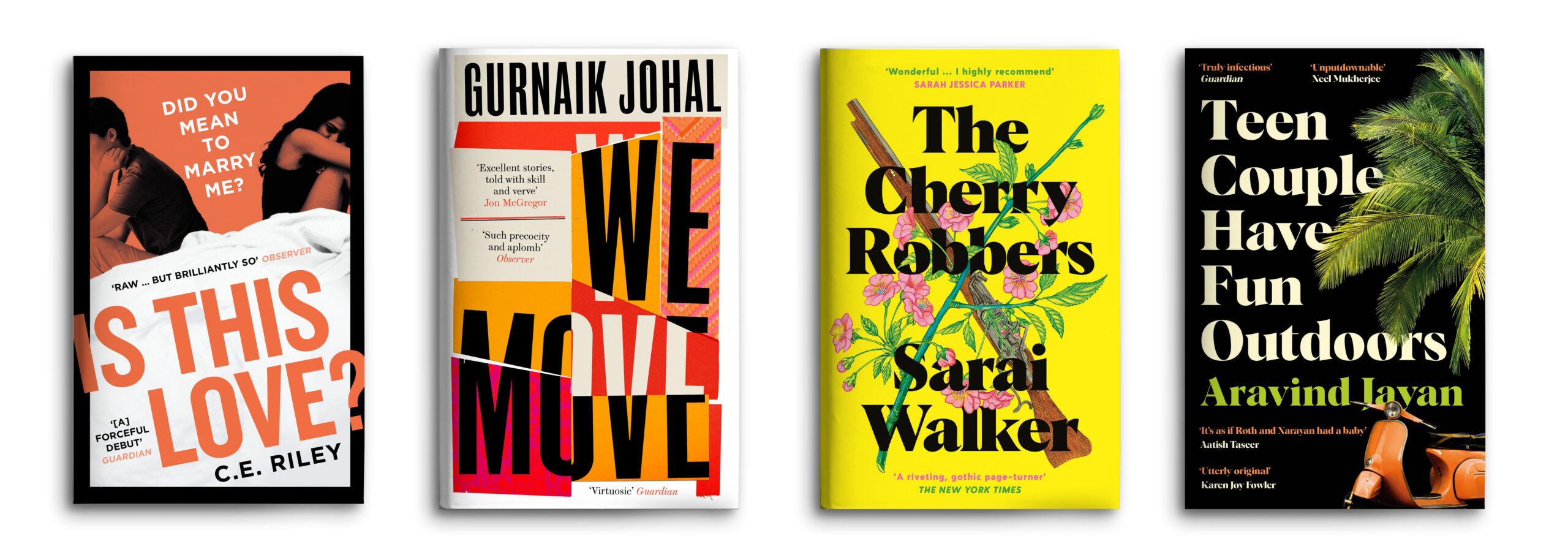
FOUR FRESH PAPERBACKS

Is This Love? by C.E. Riley

A searing literary debut with the compulsive qualities of a thriller… J’s wife has left, and J is trying to understand why. Narrated by J in the days, weeks and months after the marriage collapses, Is This Love? is an addictive, deeply unsettling, and provocative novel of deception and betrayal, and passion turned to pain.

We Move by Gurnaik Johal

Mapping an area of West London, these stories chart a wider narrative about the movement of multiple generations of immigrants. In acts of startling imagination, Gurnaik Johal’s debut brings together the past and the present, the local and the global, to show the surprising ways we come together.

The Cherry Robbers by Sarai Walker

First they get married, then they get buried. The Cherry Robbers is a wonderfully atmospheric, propulsive novel about sisterhood, mortality and forging one’s own path.

Teen Couple Have Fun Outdoors by Aravind Jayan

A scandalous video.
A humiliated family.
And a brother stuck in the middle.

Full of bittersweet comedy, and insight into contemporary Indian society and an online generation, this is a story about now with the feel of a classic.

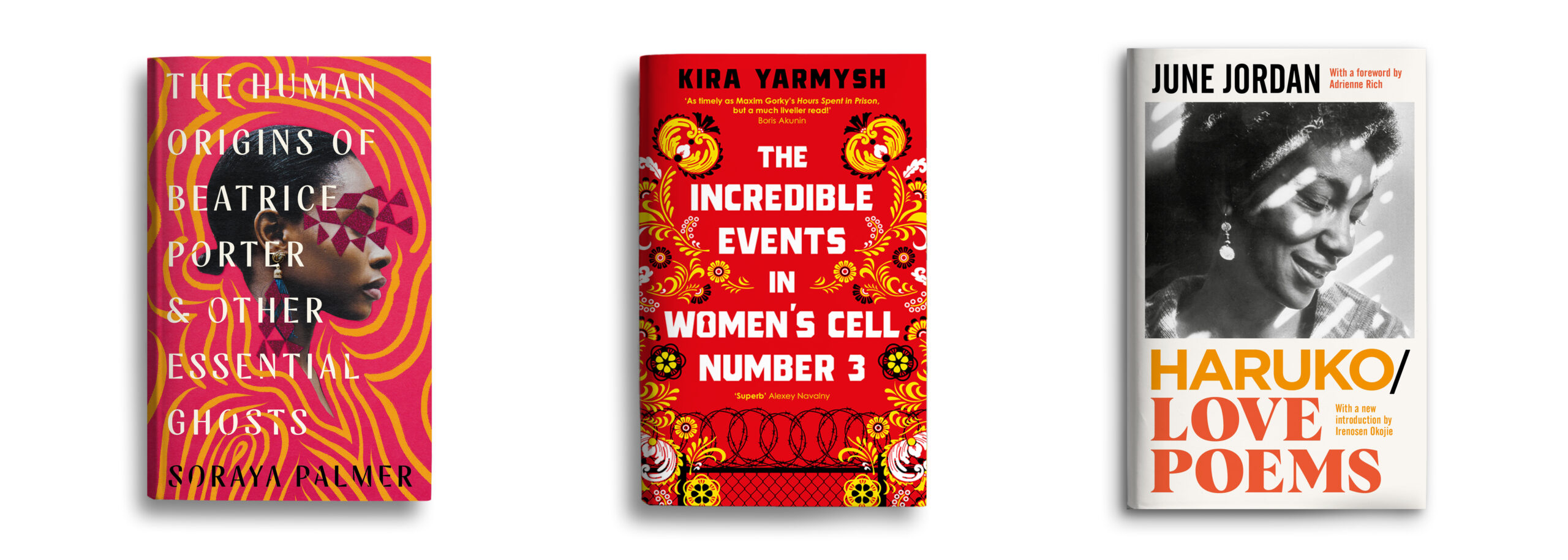
THREE HOT NEW TITLES

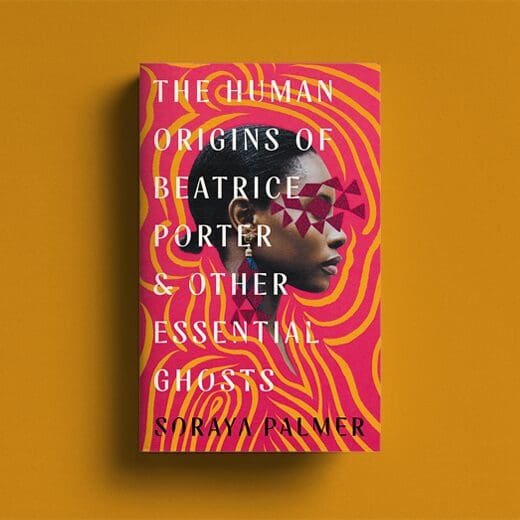
The Human Origins of Beatrice Porter by Soraya Palmer

Life at home has become unbearable for Zora and Sasha. But they can’t hide forever. The Anansi Stories that captivated them as children begin to creep into the present, revealing truths about the Porter family’s past they must all face up to…

This is an extraordinary debut novel that asks – what happens when our stories are erased? Do we disappear? Or do we come back haunting?

The Incredible Events in Women’s Cell Number 3 by Kira Yarmysh

*WINNER OF THE ENGLISH PEN AWARD*

When Anya is arrested at a Moscow anti-corruption rally, she is given a sentence at a detention centre. But her cellmates are not thieves, crooks and murderers…

A brilliant exploration of what it means to be marginalized in an increasingly intolerant Russia in particular, this explosive debut introduces one of the most urgent and gripping new voices in international literature.

HARUKO/Love Poems by June Jordan

Searingly beautiful poems about compassion, resistance and desire by an iconic Black American activist and writer. June Jordan’s spectacular poetry remains profoundly politically potent, lyrically inventive and breathtakingly romantic. First published in 1994, it is a vitally important modern classic.

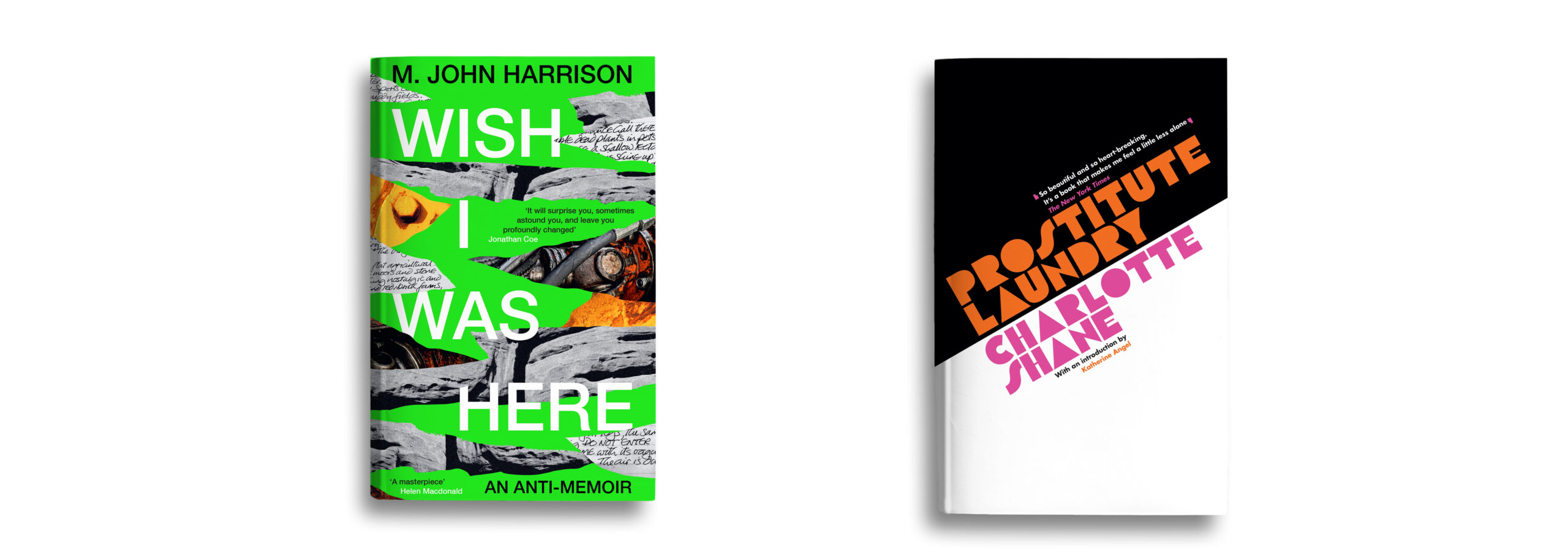
TWO INCREDIBLE MEMOIRS

Wish I Was Here by M. John Harrison

Wish I Was Here is a masterpiece’ Helen Macdonald
‘It will surprise you, sometimes astound you, and leave you profoundly changed’ Jonathan Coe

One of our greatest and most original living writers sets out the perils of the writing life with joyful provocation. This is his first memoir, an ‘anti-memoir’, written with aphoristic daring and trademark originality and style.

Prostitute Laundry by Charlotte Shane

Prostitute Laundry is a taboo-breaking and radically honest account of love, friendship and sex work. This serial memoir follows Charlotte over the course of several years as she falls in and out of love, muses on the nature of sex work and the value of beauty, discovers hidden emotional complexities and contemplates leaving her profession.

ONE GREAT SUMMER TO LOOK FORWARD TO

Bliss & Blunder by Victoria Gosling

An inventive, magisterial reworking of the King Arthur legend for the 21st century and a heartrending novel of power, friendship and betrayal.

Girlfriend on Mars by Deborah Willis

A satirically funny, poignant and dark novel for fans of cool contemporary fiction. Follow weed-growing couple Kevin and Amber as Amber is selected for a reality TV to win a one-way ticket to Mars.

Cheri by Jo Ann Beard

A masterpiece of fiction and memory, Cheri is a heart-breaking but glorious celebration of all the moments of beauty and pain that make an individual life, right up until its very last moments.

Posted on

The Incredible Events of Women’s Cell No.3 – Read an extract

Winner of a PEN Translates Award

‘The whole world through a single cell: frightening and funny, absurd and all too real’ Julia Phillips, author of Disappearing Earth
‘As unpredictable as it is damning’ Wall Street Journal
‘Kira Yarmysh has succeeded in creating a sensitive, angry, and often funny portrait of Russian society’ Deutsche Welle

When Anya is arrested at a Moscow anti-corruption rally under false pretences, she is given a 10-day sentence at a detention centre. Her cellmates are five other ordinary women arrested on petty charges.

Ten listless days stretch before Anya and, as she appeals her sentence and recalls her progress from apolitical youth to informed citizen, she is troubled by strange, dreamlike visions, and wonders if her cellmates might somehow not be as ordinary as they seem.

A brilliant exploration of what it means to be marginalized both as an independent woman and in an increasingly intolerant Russia in particular, The Incredible Events in Women’s Cell Number Three introduces one of the most urgent and gripping new voices in international literature.

Read an extract below.

Order your copy: Waterstones | Bookshop.org


DAY ONE


If you asked Anya which day in prison had been the most trying, she would say the first. It had seemed both insane and endless. Prison time was elastic: it stretched out interminably, only to then fly like an arrow.

It started with her waking up on a clammy, impermeable mattress in a detention cell in a Moscow police department. She had been arrested the day before, but her efforts to outrun the riot police, her journey in the police bus, and her registration at the police department had kept her busy enough to all but overlook how it had ended. The reality of being in police custody struck her only once she was locked in that cell.

She had spent the night tossing and turning on the mattress, trying to pull her top down to avoid her body coming into contact with the oilcloth. The mattress was on the floor, there were no pillows, no blankets, and it was impossible to get comfortable. Either the arm under her head went numb or she got pins and needles in her side. She could only tell that she had managed to get some fitful sleep when she jerked awake, which happened many times.

What the time was, she had no idea. The cell was windowless, with only a dim light bulb above the door, which stayed on night and day. Her phone had been taken from her. Each time she woke, for want of anything else to do, she entertained herself by inspecting the wall in front of her: the peeling paint that looked like crushed eggshells; the suspicious streaks whose origins she preferred not to think about; the graffiti: Lex, Up Biryulyovo!, Allahu Akbar. Waking up one last time with a jolt, Anya realized she was not imagining it: she could feel a tremor under the floor, the metro must be open, morning had arrived.

The police department began coming to life, as Anya could hear through her cell door, which had been left ajar overnight. A kindly, older cop had not locked it but left it open a handbreadth. (A chain on the outside ensured she opened it no farther.) She lay, listening to the police arguing among themselves in the reception area, the telephone ringing off the hook, the rasping of a door lock, water flushing in a toilet she was eventually taken to visit. A policeman let her in and stayed outside to keep the door shut.

Anya dithered and looked around her. A scene from Trainspotting came to mind, where the main character goes to “the worst toilet in Scotland.” He had clearly seen nothing like the one in the Tverskaya
police department, with its chipped tile floor awash with murky fluid. A rusty chain hung from the water tank, and as for the toilet itself, it was a hole in the ground. Anya decided against going anywhere near
it. Running the faucet for appearances’ sake, while avoiding all contact with the squishy remnant of soap on the filthy edge of the washbasin, she emerged, and the policeman took her back to the cell.

Time passed with demoralizing slowness. Her cell door was now shut tight and did not allow in any outside sounds. She ran her eyes over the walls, which were barely visible in the dim light, but it was
an unrewarding pastime. She felt heavy and clumsy from lack of sleep, and thoughts stirred sluggishly in her head. Anya could not tell how long she sat like that. Her heart seemed to begin beating more slowly
and she felt she was sinking into a trancelike state; perhaps, indeed, suspended animation. When the door opened and a policeman came into the cell, Anya was startled, not sure what was happening.

She was taken through to the reception desk and told to sit on a bench next to a sad-eyed woman who looked Roma, a young guy who was drunk, and a man with a large black eye. The fatherly cop who
had left her door partly open took the box of her belongings out of a closet. “Get yourself together,” he said. “You have to go to the court hearing.” Anya turned on her phone, quickly checked her messages,
put her belt back on and laced up her sneakers. (The laces had been taken from her before she had spent the night in the cell.)

“Don’t make too much effort,” the cop advised. “You’re going to court.”

Posted on

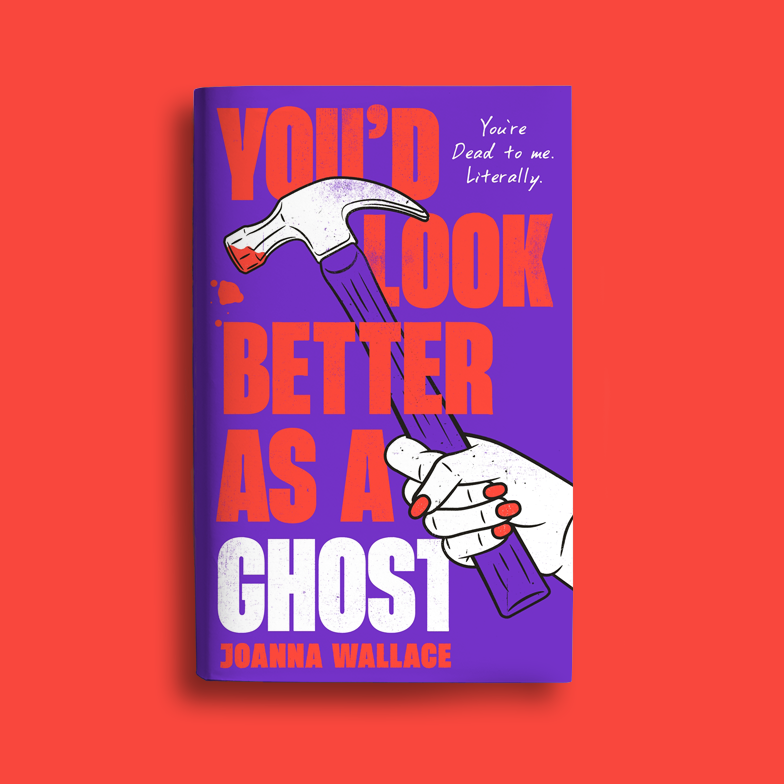
You’d Look Better As a Ghost: read an excerpt

‘Refreshingly original and laugh-out-loud funny’ – CLARE MACKINTOSH
‘Delightfully shocking and irreverently funny’ – JANICE HALLETT
‘If Bret Easton Ellis ever went to grief counselling, this would be just the kind of brilliant book he’d write’ – PHILIPPA EAST

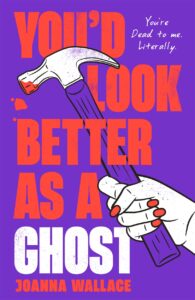
I have a gift. I see people as ghosts before they die.

Of course, it helps that I’m the one killing them.

The night after her father’s funeral, Claire meets Lucas in a bar. Lucas doesn’t know it, but it’s not a chance meeting. One thoughtless mistyped email has put him in the crosshairs of an extremely put-out serial killer. But before they make eye contact, before Claire lets him buy her a drink, even before she takes him home and carves him up into little pieces, something about that night is very wrong. Because someone is watching Claire. Someone who is about to discover her murderous little hobby.

The thing is, it’s not sensible to tangle with a part-time serial killer, even one who is distracted by attending a weekly bereavement support group and trying to get her art career off the ground. Let the games begin…

Dexter meets Killing Eve in this superb thriller, perfect for fans of How To Kill Your Family and My Sister the Serial Killer.

Read the opening below.

PRE-ORDER YOUR COPY


CHAPTER ONE

She looks about the same age as me, early thirties, and she’s piling the plates precariously. I wonder whether she’s in a rush or just enjoys the excitement of seeing how many she can stack before they fall. There are nine plates piled on the tray with a selection of cutlery on top. She turns towards the kitchen and hesitates. She’s spotted another plate. Surely not. She reaches for the tenth plate and balances it on top of the cutlery. I take a sip of red wine and look away from the waitress. The serious-looking men in serious black suits are standing seriously too close and staring at me. Are they waiting for me to talk?

‘Claire,’ one of them says, ‘like I was saying, I’m so sorry about your dad. He was a good man. One of the best.’

One of the best? What a curious accolade. Out of how many? The whole world? This room?

‘He was such a lovely man,’ someone else is saying now. Another solo voice emerging from a chorus of gentle agreement. They look like a depressed choir, all these men who used to work with my dad. The choir that charisma forgot.

‘Always so calm,’ continues the soloist. ‘In fact, do you know something, Claire? I can’t ever remember a time when I saw your dad rattled. Not once! In all the years I knew him, he never got rattled. No matter what was going on, he was always so calm.’

‘You’re so right!’ someone else is saying now. ‘He never got rattled, did he? It was extraordinary, now I think about it. I never saw him rattled. Not ever.’

I stand here, watching their mouths move, and wonder about all the funerals in the history of the world. All the funerals that have happened since the beginning of time. How many billions of funerals must there have been? Hundreds of billions? Thousands of billions? Trillions? How many billions in a trillion? And has there ever been a funeral, I wonder, since records began, that has seen such a peculiar overuse of the word ‘rattled’?

‘I remember one time, must be thirty years ago now,’ says another voice, ‘me and your dad, we were working together on this huge project and, let me tell you, the deadlines were unbelievable! Everyone – well, almost everyone – was panicking. The boss was panicking, the client was panicking, and I don’t mind telling you, I was the most nervous of wrecks! But your dad, Claire, he wasn’t one bit rattled. Nothing ever seemed to rattle him.’

Posted on

Prostitute Laundry by Charlotte Shane: A sneak peak at the first chapter

The book 'Prostitute Laundry' on a background which mirrors its cover's diagonal split between black and white.

A taboo-breaking and radically honest account of love, friendship and sex work.

The book 'Prostitute Laundry' on a background which mirrors its cover's diagonal split between black and white.A Stylist ‘Non-fiction You Can’t Miss’ selection for 2023

‘Addictive, intimate . . .’ VICE

‘[Prostitute Laundry] is so beautiful and so heartbreaking. It’s a book that makes me feel a little less alone.’  New York Times Book Podcast

‘Stunning writing …  everything from high end sex work to the emotional labour of long-term relationships for women.’ Arifa Akbar, author of Consumed

This serial memoir follows Charlotte over the course of several years as she falls in and out of love, muses on the nature of sex work and the value of beauty, discovers hidden emotional complexities and contemplates leaving her profession. Growing out of a series of confessional letters sent by the author to a small but devoted mailing list, her candid, unstinting and sometimes heart-breaking meditations have gained thousands of subscribers and a cult status.

Prostitute Laundry is a deeply thoughtful book about sensuality, money, and identity – how those forces can break us, and how they can make us whole again. By turns philosophical, funny and explicit, this is an affecting, immediate account of one life lived to its fullest.

Read the sneak peak below.

Order your copy


Searching

Bleak Week

February 8, 2014

This week, my most frequent regular said he’d come up with an idea. One of us would give the other explicit sexual instructions (that the other was free to refuse) but the one being instructed couldn’t do anything spontaneously. They simply had to obey. He said I could choose who took which role and that was easy—I said he should be in charge. It’s no secret that many sex workers hate the ubiquitous “tell me what you want to do” client line.

But I wasn’t off the hook yet. Because he added that whoever obeyed this time would have to instruct next time, and then he proceeded to cheat. “Put your hand on my hand and guide me,” he said with his fingers between my legs. “Put your hands on my head and guide me,” he said later. He asked for 69 by prefacing it with, “I know you don’t like this”—or “I know this isn’t your favorite,” maybe, which is so mildly stated that it’s almost a lie—“but since I’m the one deciding . . .”

I thought about this for days. Normally he is someone I like and feel warmly toward, but the fond regards now felt poisoned by reality: he hires me, I do what he wants. Why did he preface the request with admission of his knowledge? Why not pretend he forgot? Why announce the irrelevancy of my pleasure or desires when it comes to his own enjoyment? This is a man who has said he loves me, with whom I’ve spent copious amounts of time since we met three years ago.

I tried to think of an instance when I’d done something like that to someone else, and I succeeded. Years ago, when my boyfriend and I were still relatively new, I asked him to let me go down on him for a while even though I knew he didn’t really like it. I wanted to convince him to like it and I thought I had a decent chance of pulling it off. But I couldn’t, so I didn’t ask it of him again. I wish I knew then what I know now, which is to trust another person’s knowledge of their body enough to not force sensation, no matter how much you might like stimulating them that way. I was in my early 20s at the time.

There are lots of examples of men ignoring what I tell them I don’t like, and those men are not all clients. But they are men in their 30s, 40s, 50s, beyond. They should have learned better a long time ago. It happens with anal penetration, with receiving oral. Normally I endure more than I deny at work. But if I see an opportunity for discussion or just can’t take it anymore, I’ll say, “I don’t really like that” or “That doesn’t feel good.” It’s very rare that this makes anyone stop. Even outside of work, when I immediately tell guys not to go down on me, they’ll try to dive between my legs and change my mind. If only they knew how many other mouths have tried, I think, forgetting that even then they wouldn’t be dissuaded.

My boyfriend has a habit of pinching or sucking on my nipples whenever I’m topless around him. I sleep naked, and I change clothes in front of him. We shower together. I know, without fail, that in these circumstances he’s going to reach for my nipples in spite of the fact that I’ve told him many times not to do it and that I don’t like it, in spite of me crossing my arms over my chest, actively resisting him, moving away, whining “no” while it happens. This is from someone I’ve been with for many years. He knows what I do for work, but perhaps makes no connection between what I tolerate there and what I tolerate at home. Or, the more probable option—feels entitled because of what I allow at work.

I don’t like being this pessimistic and cynical and angry about sex, especially when I used to sincerely love it, but I don’t have many moments of sexual joy. The ones I try to create can backfire and seem not worth the risk, leaving me more disenchanted than I was before. A few months ago I managed the mundane rape attempts of a very large, condom-less man who didn’t even pay me for my troubles. It wasn’t traumatic, but it was a frustrating, stupid waste of time and energy that deepened my bitterness.

The way I feel about sex corresponds with the way I feel about (straight) men in general, and vice versa, which makes it all the more fatiguing. I hate dwelling on this evidence, but it keeps accumulating. Fairly frequently, a man says he loves me, but then communicates that his urge to use my body in a certain way is more important than any displeasure it brings me, more important than my right to say no. “Why don’t you care when I say I don’t like it?” I should ask. “Why does my unhappiness enhance your pleasure, or impact it so negligibly that it’s still worth it?” But I don’t think I would ever get an honest answer. At least not one I couldn’t already arrive at on my own.

Posted on

Five Things to Know About M. John Harrison

A photo of M. John Harrison, an older white man with white hair pulled back into a ponytail and a white goatee. He is on a light green background with the book 'Wish I Was Here' behind him.

Meet the legendary author of the anti-memoir Wish I Was Here.

A photo from the chest up of M. John Harrison, an older white man with white hair pulled back into a ponytail and a white goatee. He is wearing black and is in front of a black background.

– M. John Harrison created Wish I Was Here out of two hundred thousand words of notes taken over a period of roughly fifty years. ‘So there’s probably another book in the remaining one hundred & fifty thousand somewhere…’ he says.

– Neil Gaiman’s favourite work by M. John Harrison is the Viriconium sequence, which he calls ‘fascinating and delightful’ and for which he wrote the introduction for a U.S. edition.

– His most nominated and awarded novel is Nova Swing; It won the Arthur C. Clarke and Philip K. Dick Awards and was nominated for the British Science Fiction Award, the British Fantasy Award, and the John W. Campbell Award.

– One of his own favourite works of his is Climbers, a novel about his other passion—rock climbing—which was widely rejected by the climbing community.

–  Though he has been labelled as ‘one of the restless fathers of modern S[ci-]F[i]’ by Robert Macfarlane and a foundational writer in the development of the New Weird, Harrison rejects stylistic categorisation—unsurprising for a self-identified anarchist.


Wish I Was Here comes out 25th May. Order yours here.

Posted on

The Human Origins of Beatrice Porter and Other Essential Ghosts: read the opening

A Today Show Most Anticipated Book of 2023
An Electric Literature Recommendation for 2023
A Goodreads Buzziest Debut of 2023

‘A beautiful ode to the power of storytelling’ Eleanor Shearer

‘A brilliant, compelling exploration of familial legacies. A mythic and edifying read’ Irenosen Okojie, author of Speak Gigantular

Growing up in Brooklyn with their Caribbean parents, Zora and Sasha Porter’s days were enchanted by stories from the islands – the mischievous spider Anansi both seductive and vengeful; the flame-breathing Rolling Calf who haunts butchers; and ocean-dwelling Mama Dglo, said to be half snake, half human.

Now they are teenagers, and life at home has become unbearable. Their parents’ tempestuous relationship has fallen apart, their mother Beatrice desperately ill, their father Nigel living with another woman. While an unsettled Zora escapes into her journal, dreaming of being a writer, Sasha discovers sex and chest binding, spending more time with her new girlfriend than at home. But they can’t hide forever. The Anansi Stories that captivated them as children begin to creep into the present, revealing truths about the Porter family’s past they must all face up to.

The Human Origins of Beatrice Porter and Other Essential Ghosts is an extraordinary debut novel, a celebration of the power of stories that asks – what happens when ours are erased? Do we disappear? Or do we come back haunting?

Read the opening below.

Order your copy


PROLOGUE

What’s My Name?

A Prelude

By the time you finish reading this I will be dead and you, dear reader, will have forgotten all about me.

You see I am what they call Your Faithful Narrator, found in places the West calls fairy tales, what men call gossip, what children call magic. Let me tell you a story. This one we call the first. It is a story that sounds like all the others, and yet it is also the one that has allowed for the existence of all that will come afterward—but we’ll get to that.

In this story, two women sit inside a bar. The first one says, “Let me tell you a story.” The second says, “So, tell me already!” “Okay, okay,” she goes. “Once upon a time, there was a girl,” she starts and looks into her drink. Her tongue starts to hang out like an udon noodle. “Well, go on,” the friend says, mistaking her hanging tongue for excitement. Only the girl’s tongue won’t move. The girl’s breath is fixed in midair. Her lips form the letter O. Her friend pricks the tongue with her fork to see what’s the matter, and the tongue falls out and skitters like worms on the ground. The bartender scoops up all the pieces he can find, and they wriggle in his hands. He worries about the mess he’s made. He asks the friend to fetch a jar and cap from the top shelf of the bar in order to contain the skittering tongue pieces. He looks down and notices no blood—only eraser dust.

The bartender thinks this is strange, but he goes to the bar to fetch his needle and thread. He begins to sew the tongue back together for the girl. This is a very difficult job for the man, as the pieces of her tongue keep moving. Like the tongue doesn’t want to be caught. Mountains of eraser dust are flying from her mouth, getting all over the floor. Her breath stands before them. The bartender does a good job of mending except that he sews her tongue onto a piece of paper and stuffs it into her mouth. The girl and her friend rejoice as the girl begins to speak again. But every time she tries to tell her story, the words come out backward. The ending changes.

Let me tell you a story. This one will give you hope. Once upon a time there was a girl. And this girl grew to be a woman. And this woman had the ability to conjure stories from ghosts. Now the conjure woman had three daughters who loved her stories so much that when she died it was all that she left them. Little did they know that these stories had a life before them. That this book had a life before me.

You see, the woman and her family existed in a place called Brooklyn where the maples lined the pavement, and the houses were made from limestone and brownstone that glittered like stars do under moonlight. It must have been divine providence that whitefolks refused to live on these streets, believing they were haunted, therefore leaving the most beautiful houses to be claimed by the descendants of slaves from all across the Atlantic.

Whitefolks were not entirely wrong about the haunting either. If you were to walk down these streets, you might hear the faint sound of steel drum and boom box and chickadee and pigeon. Or you might hear the chattering of ghosts—the spirits of colonialists, Ashanti warriors, slave holders, African griots, mythic creatures, and stories long since forgotten. But while whitefolks may call this a haunting, we know them to be the ancestors. After all, they only want to be able to walk through their homes like they did before their deaths—to sit in the kitchen drinking Milo, bestowing wisdom onto their children who are at risk of forgetting all about them.

Now this family lived in the only rose-colored building at the end of Maple Street. The youngest called herself Zora or She Who Will One Day Grow Up to Be a Great Writer Like Her Namesake. She could be found conjuring her mother’s words into stories or if not, she could be caught, face flushed with embarrassment, fantasizing about a boy or two.

And then there was Sasha, the eldest, who felt her story should shine brightest for once. Commonly referred to as the Black Sheep or She Who Nearly Disappeared Until She Found Her True Self—this girl did have spunk. They say the girl had a chip on her shoulder the size of El Tucuche Mountain for nearly everyone, but particularly for her father who, legend had it, defeated a Rolling Calf with only a penknife and the power of his gaze.

Posted on

A Flaw in the Design: read the opening

A nephew. An uncle.

A psychopath – but which of them is it?

Gil knows his nephew Matthew is dangerous. The signs were there early – on a family holiday Gil’s daughter was discovered nearly drowning at the bottom of a swimming pool, while Matthew looked on from the deck.

Now seventeen, Matthew is orphaned when his parents die in a car crash. He must leave his Upper East Side Manhattan life behind, to live with Gil, his wife and daughters in rural Vermont. He is insolent, bored, disconnected. At least that’s Gil’s take. To the women in the family he is charming, intelligent, wry.

But when he disdainfully joins Gil’s writing classes at the local university, Matthew’s fiction shows a vivid and macabre imagination spilling onto the page. Matthew is clearly announcing his intentions to Gil, taunting him before he does something awful to his family. But why is Gil the only one who can see this? As Gil begins to follow Matthew around, his own behaviour becomes increasingly unstable. Is he losing his mind? Which of the two of them is likely to kill someone?

Order your copy


There was still time to turn and walk out, pretend he’d never come. The screen, perched on a pillar near baggage claim, listed the New York flight as arrived. Gate 3. Any minute, passengers would come down the escalator in front of him. But right now, he could leave. Escape before his nephew spotted him. Concoct some excuse to tell Molly: The flight was canceled; no, he wasn’t answering his phone. Weird, right? Well, maybe tomorrow. Except no, not really. After all, he was the boy’s guardian, and they’d track him down. Or the boy would find his own way to their house and that’d be worse, because then he’d know how much Gil feared him. Hated him. Which was the wrong way to think. He should stop. He couldn’t stop.

A loosely strung crowd came down the escalator, hurrying through the nearly empty terminal to claim spots at the baggage carousel. Already it was too late. There he was: Matthew, in a short black down coat that was too light for the Vermont winter, a bright white shirt beneath; hair styled in a swoosh; on his face a smirk, the slightest turn of his lips, familiar enough to bring loathing into Gil’s throat.

He’d known that the boy would look different after all this time, but he wasn’t prepared for this. Once a lanky kid, he was now over six feet, a couple of inches taller than Gil. Matthew stepped around an old man who fumbled with a coat and a rolling bag, bored annoyance moving over his face, as if this was routine, as if he was a young businessman sent from the city to check on some far-flung investment.

Gil waved, and in the acknowledging tilt of Matthew’s head he caught a glimpse of his sister. Sharon. Who was dead. Who’d left him this. Her son.

“Well, hello, welcome,” Gil said, opening his arms, but the boy stepped back, as if he didn’t recognize this gesture, or the man behind it. “How was the flight?”

“The flight?” Matthew said, frowning at the darkened check-in kiosks, the empty car rental desks, the snow blowing in streaks across the asphalt outside, his dopey uncle in his black parka and clumpy winter boots. “I guess it was like most flights. Fine, in that I don’t remember anything about it.”

“That’s great,” Gil said. “Do you have any bags?” He pointed at the crowd staring forlornly at the unmoving gray belt.

“Nope. All set,” Matthew said, tugging at his shoulder strap.

Should Gil offer to carry it? But the bag was small and easily managed, as if the boy was only here for a weekend. Matthew gave him an indifferent squint, knowing he must wait to be led, though the dynamics that subordinated him to this person were clearly a miscarriage of justice, given their true stations in life. Or Gil was just being a dickhead. Maybe Matthew was standoffish because he felt awkward: coming to live with his uncle he hadn’t seen in years. That might explain the constricted approximation of a smile. He expected Gil, the adult, to take the lead.

Posted on

Blue Water is Waterstones Thriller of the Month

We’re are thrilled that Leonora Nattrass’ brilliantly page-turning, sea-faring mystery Blue Water has been chosen as Waterstones Thriller of the Month for February! A tale of murder, espionage and treason, this is the perfect book for thriller lovers and historical fiction fans alike.

New Year 1795, and Laurence Jago is aboard the Tankerville mail ship, en route to Philadelphia. Laurence is travelling undercover, supposedly as a journalist’s assistant. But his real mission is to protect a civil servant, travelling to Congress with a vital treaty that will stop the Americans from joining the French in their war against Britain.

When the civil servant meets an unfortunate – and apparently accidental – end, the treaty disappears, and Laurence realises that only he can keep the Americans out of the war. Trapped on the ship with a strange assortment of travellers including two penniless French aristocrats, an Irish actress and a dancing bear, Laurence must hunt down both the lost treaty and the murderer, before he has a tragic ‘accident’ himself…

Hurry to Waterstones to get their exclusive paperback edition, featuring bonus material from Leonora’s next book. Get your copy here!


Posted on

László Krasznahorkai’s new book: read an extract

A Mountain to the North, A Lake to the South, Paths to the West, A River to the East

The grandson of Prince Genji lives outside of space and time and wanders the grounds of an old monastery in Kyoto. The monastery, too, is timeless, with barely a trace of any human presence. The wanderer is searching for a garden that has long captivated him.

This novel by International Booker Prize winner László Krasznahorkai – perhaps his most serene and poetic work – describes a search for the unobtainable and the riches to be discovered along the way. Despite difficulties in finding the garden, the reader is closely introduced to the construction processes of the monastery as well as the geological and biological processes of the surrounding area, making this an unforgettable meditation on nature, life, history, and being.

László Krasznahorkai was born in Gyula, Hungary, in 1954. He has written five novels and won numerous prizes, including the 2013 Best Translated Book Award in Fiction for Satantango, the same prize the following year for Seiobo There Below, and the 1993 Best Book of the Year Award in Germany for The Melancholy of Resistance. He won the Man Booker International Prize in 2015 rewarding an outstanding body of work. His books have been translated into more than thirty languages. He lives in the hills of Pilisszentlászló in Hungary.

Order your copy


II

The train did not run along tracks, but along a single terrifying blade edge, so that the balanced order of the city traffic with its ominous frenzy and trembling inner panic that announced the arrival of the Keihan train was the beginning — to get out at Shichijō Street, on the side where the Rashōmon, now vanished without a trace, had once stood in the Fukuine district, and suddenly the buildings were different, the streets were different, as if at once the colors and forms had been lost, he sensed he was already outside the city limits, altogether with a single stop he was outside of Kyoto, although of course the city’s deepest secrets were not lost here, and especially so quickly; and so there he was, to the south, the southeast of Kyoto, and he started off from there along the narrow and labyrinthine streets, turning to the left or continuing straight ahead, then turning to the left again, and in the end he should have been beset by the greatest of doubts, and as a matter of fact he was, and yet he didn’t stop, he made no inquiries and asked no directions, precisely the opposite: he went on asking nothing, he did not reflect, he did not hesitate at this or that corner, wondering: which way now, because something suggested to him that he would still find what he was looking for; the streets were empty, the shops were closed, now it seemed as if there weren’t even anyone to ask for directions because somehow everything was deserted as if there were a holiday somewhere, or some kind of problem — but somewhere else far away from here, and from the viewpoint of that faraway place this tiny district was of no interest, whoever had been here had left, everyone, to the last man, gone, not even a stray child or a noodle seller remained, no head suddenly pulled back from motionless watching behind a window grating, as one might have expected around here on a sunny, peaceful late afternoon, he established that he was alone; and he turned to the left, then he went straight on again, then he suddenly noticed that for a while the ground had been rising, the streets on which he walked, whether heading to the left or straight, had, for a while, been unequivocally leading upward, he could not establish anything more certain than that, could not say whether the incline had begun in this or that specific spot, instead there was a kind of realization, a determined overall sense: the entirety, along with him, had been ascending for a while — he reached a long enclosure wall running to the left of him, unornamented and constructed from mud bricks assembled into bamboo framework, it was painted white, its upper edge laid with crosswise, slightly battered turquoise-blue roof tiles; the footpath ran along it for some length, and nothing happened, he couldn’t see anything above the wall as it had been built too high for someone to glimpse what was on the other side, there was no window, tiny door, or even a crack-sized opening; when he reached the corner, he turned to the left and from there, for a bit longer, the path followed the wall closely until finally it came to an end, its direction cumulating in a refined bridge of light wooden construction that appeared to be floating, precisely because of its refined and light character; it was covered by a roof constructed of cypress bark, its columns made of cypress wood, burnished to perfection and supporting the soft, rain-battered flooring that swayed gently when stepped upon, and on either side: there were depths, and everything was green.

Posted on

The Homes is Waterstones Scottish Book of the Month

We’re starting 2023 off with a bang: The Homes by J. B. Mylet has been picked as Waterstones’ Scottish Book of the Month for January!

Based on the true story of a childhood growing up in a home for abandoned and unwanted children, The Homes is a haunting thriller with an unforgettable voice perfect for fans of Val McDermid and Chris Whitaker.

A thousand unwanted children live in The Homes, a village of orphans in the Scottish Lowlands on the outskirts of Glasgow. Lesley was six before she learned that most children live with their parents. Now Lesley is twelve, and she and her best friend Jonesy live in Cottage 5, Jonesy the irrepressible spirit to Lesley’s quiet thoughtfulness.

Life is often cruel at The Homes, and suddenly it becomes much crueller. A child is found murdered. Then another. With the police unable to catch the killer, Lesley decides to take the matter into her own hands. But unwanted children are easy victims, and Lesley is in terrible danger…

Adored by readers in hardback for its moving plot and the heart-warming relationship between best friends Lesley and Jonesy, The Homes is a thriller not to be missed! Buy the paperback from Waterstones at discount now!

Posted on

The Serpent’s Tail Book Club – DECEMBER 2022

DECEMBER 2022: I LOVE DICK

We’ve got an absolute treat in store for you for our Serpent’s Tail December Book Club pick: Chris Kraus’ iconic novel I Love Dick. A cult classic, this fiery feminist read continues to entertain readers 25 years down the line with its funny and relevant exploration of love, relationships and our own personal philosophy. We can’t wait for you to discover the gem that is I Love Dick…!

Find more about the Serpent’s Tail Book Club and FAQs here.

ABOUT THE BOOK

When Chris Kraus, an unsuccessful artist pushing 40, spends an evening with a rogue academic named Dick, she falls madly and inexplicably in love, enlisting her husband in her haunted pursuit. Dick proposes a kind of game between them, but when he fails to answer their letters Chris continues alone, transforming an adolescent infatuation into a new form of philosophy.

Blurring the lines of fiction, essay and memoir, Chris Kraus’s novel was a literary sensation when it was first published in 1997. Widely considered to be the most important feminist novel of the past two decades, I Love Dick is still essential reading; as relevant, fierce and funny as ever.

ABOUT THE AUTHOR

Chris Kraus is the author of the novels Aliens and AnorexiaI Love Dick, and Summer of Hate as well as Video Green: Los Angeles Art and the Triumph of Nothingness and Where Art Belongs. A Professor of Writing at the European Graduate School, she writes for various magazines and lives in Los Angeles.


READING GROUP QUESTIONS

  1. Why does Chris start writing to Dick? Why does she keep writing to him?
  2. How do you see Chris and Sylvere’s relationship change throughout the novel?
  3. In a letter to Dick, Sylvere asks ‘Would Chris have fallen in love with you if I hadn’t been there to make it so embarrassing?’ What do you think?
  4. Do you think Dick owes Chris more than he gives? Why/why not?
  5. All three characters often equate infatuation with adolescence. Do you think this allows Chris to feel less responsible of her feelings?
  6. Throughout Chris and Sylvere’s infatuation with Dick, he isn’t a willing participant. Would you classify their actions as harassment or an extreme of performance art?
  7. Chris says, ‘Art, like God or The People, is fine for as long as you can believe in it.’ How does this system of belief manifest itself in the novel?
  8. Did any of Chris’ many cultural criticisms in her letters speak to you?
  9. Some might say Sylvere is brave in his acceptance of Chris’ crush on Dick, some might call him cowardly and dependent – do you agree with either judgment?
  10. I Love Dick has been a highly divisive novel since publication, yet has grown a rather large cult following. Why do you think that is?
Posted on

Queen K: Read the opening

On a balmy evening in late March, an oligarch’s wife hosts a party on a superyacht moored in the Maldives. Tables cover the massive deck, adorned with orchids, champagne bottles, name cards of celebrities. Uniformed staff flank a red carpet on the landing dock. This is what Kata has wanted for a long time: acceptance into the glittering world of high society. But there are those who aim to come between Kata and her goal, and they are closer to home than she could have imagined.

Witness to the corruption and violence underneath the shiny surfaces is Mel, a young English woman employed to tutor Kata’s precocious daughter and navigate her through the class codes of English privilege. Now the closest Mel gets to such privilege is as hired help to the wealthy, and she is deeply resentful.

Exquisitely written and deliciously unreliable, Queen K takes the reader to some of the most luxurious places in the world. But a dark refrain sounds from the very beginning of the story and grows towards its operatic finale: a novel about insatiable material desire can only ever be a tragedy.

Coming February 2023.

Pre-order your copy

Request on NetGalley


I went to dinner with some old school friends the other night and before I’d been there ten minutes they were asking me about that family I used to work for, the billionaires. Everyone does that. Everyone’s heard the story and knows I was there that night. ‘Something crazy happened, didn’t it,’ they say, ‘with that oligarch’s wife; didn’t she just disappear or something?’ They look at me and depending on the mood I’m in I brush them off with an arch quip or I try quite seriously to explain it all: how it came to that, how Kata got it so badly wrong.

On this particular night, I was looking at those girls from school arrayed around the dinner table, in their merino knits, comfortable in their professions: lawyer; TV producer; book editor. I caught the whiff of glibness, that I was being patronised. ‘So exotic!’ said Charlotte. ‘Being a tutor. Makes office life seem very boring!’

Charlotte had seen I was in the country from one of my Instagram stories. I’d been packing up the last of Mum’s stuff and found a big book of photographs, all these pictures from Mum’s youth, on the seafront at Dartmouth with the sailing yachts behind her, hair blown about by that south-coast wind.

‘Wow, you look like her!’ Charlotte said. ‘Come to dinner on your way back through London. I’ll invite some of the others.’

When Charlotte led me down the hall to her kitchen it all came back to me: the lust I used to have for houses like this, the sounds of the street dying away as we passed a sitting room with heavy curtains, a faded sofa full of cushions, a fireplace and, on either side of the fireplace, blue and white china urns. Charlotte had seemed so helpless to me when we first met aged thirteen, both new at a girls’ boarding school in the West Country. There was some incident in the library, a mouse ran over her books and she screamed, then people followed her round chanting: ‘Library Mouse, Library Mouse.’ It irritated me, and one night in the dinner queue I told everyone how lame they were being. ‘Teasing Charlotte is mean and lazy, it also happens to be totally risk free. Now, how about her,’ I said, pointing to this girl a few years above us, someone beautiful and fascinating and tyrannical, known to be vicious in her punishments.

Push up, not down, I suppose is what I meant. Back then, I saw Charlotte as someone in need of my protection. It’s relentless, isn’t it, our need to order ourselves, to form hierarchies? When we were kids together at that school we were ordered by our wits, it was cruel and merciless. In the end of course we are ordered by our capital: it is cruel, it is merciless.

I think I was always aware Mum was heading towards an act of mortal stupidity, but I never saw it coming with Kata. Two such weak women. I grew up wishing my mother could have tried to hide her weaknesses from me, that she could at least have pretended to be some kind of a safe haven. So I could understand very well Alex’s feelings towards Kata, and I could even understand the role she played in the whole sad thing. She clung on to love for her mother for a long time, before that love turned to disgust. She was so sweet and so gentle, my little pupil. I could never quite work it out: was she someone I needed to protect or was she undeserving of my protection, simply because she was so rich?

The email notification was on my phone: my return flight to Vienna the very next day, my apartment, my new life. It really was there, waiting for me. I brought it all up before me in my mind: drinking a cup of coffee in my kitchen, dressing and getting on the underground to the kindergarten where I worked, late afternoons in the cafés, evenings with Jakob and friends. I called it to myself and felt its warmth fill me, then expand outwards. It radiated through Charlotte and the others, and Charlotte’s million- pound house in Clapham that her parents had bought her. I separated Charlotte from my envy, for just a moment: I looked at her across the table, at her face as she lifted the bottle of wine brought it towards my glass, the light freckles over her nose and the top of her cheeks, and for a moment I thought, Maybe we are all helpless, maybe we are all hostage. I think Kata was helpless and hostage from the beginning to the end of her life, and she was the richest of us all.

Posted on

The Serpent’s Tail Book Club – NOVEMBER 2022

NOVEMBER 2022: DETRANSITION, BABY

This month, we’ve chosen Torrey Peters’ Women’s Prize for Fiction longlisted Detransition, Baby for our Serpent’s Tail Book Club pick. 13th–19th November is Trans Awareness Week, so now is the perfect opportunity to read this bestselling novel and explore its uniquely trans take on love, motherhood, and those exes you just can’t quit. 

Find more about the Serpent’s Tail Book Club and FAQs here.

ABOUT THE BOOK

LONGLISTED FOR THE WOMEN’S PRIZE FOR FICTION 2021

Shortlisted for the 2022 National Book Critics’ Circle John Leonard Prize for best first book

As heard on BBC Radio 4’s Front Row

‘A voraciously knowing, compulsively readable novel’ – Chris Kraus
‘Tremendously funny and sexy as hell’ – Juliet Jacques
‘I loved this very smart book from start to finish, with its beautifully drawn, complicated, and winning characters’ – Madeleine Miller

Reese nearly had it all: a loving relationship with Amy, an apartment in New York, a job she didn’t hate. She’d scraped together a life previous generations of trans women could only dream of; the only thing missing was a child. Then everything fell apart and three years on Reese is still in self-destruct mode, avoiding her loneliness by sleeping with married men.

When her ex calls to ask if she wants to be a mother, Reese finds herself intrigued. After being attacked in the street, Amy de-transitioned to become Ames, changed jobs and, thinking he was infertile, started an affair with his boss Katrina. Now Katrina’s pregnant. Could the three of them form an unconventional family – and raise the baby together?


ABOUT THE AUTHOR

Torrey Peters lives in Brooklyn and holds an MFA from the University of Iowa and a Masters in Comparative Literature from Dartmouth. She is the author of two novellas, Infect Your Friends and Loved Ones and The Masker. 


Discover Torrey’s top reads for Trans Awareness Month over at her Bookshop.org shelf:


READING GROUP QUESTIONS

  1. Detransition, Baby explores motherhood through several lenses. How do Reese, Katrina and Ames’s feelings on motherhood differ and how do they converge?
  2. What does the novel reveal to you about the taboos of sex and gender? What roles do class and race play?
  3. How does Katrina’s grief from her divorce and miscarriage inform her thoughts about pregnancy? Do you see a parallel between divorce narratives and transition narratives?
  4. Discuss Reese ’s relationship with the cowboy. What does their relationship fulfil for one another?
  5. Discuss Ames’s decision to detransition. What factors played into this choice? Do you believe Ames is still a woman, even after detransition?
  6. Discuss the question of dissociation as described in the novel. How do the kinds of ‘bad feelings’ that trans women cope with by dissociating from their bodies and emotions relate to the kinds of ‘bad feelings’ that other women experience about their bodies or in uncomfortable sexual situations?
  7. How does Ames’s relationship with Katrina differ from her relationship with Reese? How are the dynamics different, and how are they similar?
  8. What was your perspective on the ending? What future do you envision for Reese, Katrina and Ames?
Posted on

Out of the Sun: Essays at the Crossroads of Race – Read an Extract

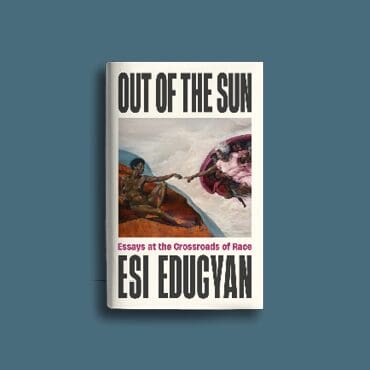
A blue square with the hardback cover of "Out of the Sun" by Esi Edugyan in the centre.

Two-time Booker Shortlistee and internationally bestselling author Esi Edugyan delivers a searing analysis of the relationship between race and art.

‘A remarkable set of essays unlike anything else’ – Kadish Morris, Guardian

As in her fiction, the essays in Out of the Sun demonstrate Esi Edugyan’s commitment to seeking out the stories of Black lives that history has failed to record. Written with the death of George Floyd and the rise of the Black Lives Matter movement in the background, in five wide-ranging essays Edugyan reflects on her own identity and experiences as the daughter of Ghanaian immigrants.

She delves into the history of Western Art and the truths about Black lives that it fails to reveal, and the ways contemporary Black artists are reclaiming and reimagining those lives. She explores and celebrates the legacy of Afrofuturism, the complex and problematic practice of racial passing, the place of ghosts and haunting in the imagination, and the fascinating relationship between Africa and Asia dating back to the 6th Century.

With calm, piercing intelligence, and a refusal to think on anyone’s terms but her own, Edugyan asks difficult questions about how we reckon with the past and imagine the future, and invites the reader to think alongside her in working out what the answers to these may be.

Buy your copy here.


Europe and the Art of Seeing

2.

Many years ago, I found myself in the overstuffed halls of Scone Palace in Scotland. I’d been living some hours away, in a castle perched above the great Midlothian fields to the south, a guest at a writers’ residency. I wanted to see more of the country before I had to leave it. The castle I’d been living at had had an air both calm and frantic. The days were lazy, open, shaped only by a sprawling evening meal shared between the residents. During the afternoons, no one was allowed to speak, to avoid disturbing others. I would walk the grounds with a fellow Canadian, a lovely writer from an island on our East coast who, as a connoisseur of human absurdity, told outrageous stories as we crossed fields as pristine and uninhabited as some imagine the outer planets to be. I adored it there but it was frustrating too – the silence was broken by the phone ringing at every hour, the castle’s Dame calling to check up on the residency’s steward, a thin, hassled man with an explosion of tawny curls who ran about in a state of panic and subservience, terrified that at any moment she might, like a figure of nightmare, leap from a closed cupboard. There were the little skirmishes between the writers, the little jealousies and romances. It is churlish, I know, to complain about staying in a castle. But it was with some relief – and some sadness as well – that I set out north.

Scone Palace was another world. One approached it in much the same way one creeps towards a mirage, with a sense it is possibly fraudulent. Built in the Georgian Gothic style, it was a dark, hulking mass high above the River Tay. At the heart of its gardens lay an exquisite maze; I have always had a terror and an attraction to mazes, drawn by their complications but knowing that to enter them with my sense of direction is to risk having the search party called out. The interiors of the Palace were as lavish as its exterior walls were stark, the rooms filled with lush velvet chairs, blue-and-gold silk rugs, draperies and mantles and chandeliers that spoke of aristocratic Georgian excess. Passing through the Gothic library into the Ambassador’s room, I was surprised by a portrait of two very elegant young women. It was for many reasons unusual, not the least because one of the sitters was a Black, or bi-racial, woman.

The piece, painted in 1778, was until the 1990s referred to as simply the portrait of Lady Elizabeth Murray. The presence of her darker companion, though central, was completely overlooked. Variously attributed to the German neoclassical painter Johan Zoffany and the British artist Joshua Reynolds, the painting is now been believed to be the work of Scottish artist David Martin, based on the style, the clothing, and the sitters’ gestures. In the portrait, which has an air of arresting strangeness to it, Lady Elizabeth is dressed in a muted pink and white gown, her porcelain skin rouged, her expression full of warmth and mischief, her pale hand holding a book as a sign of her intellect. To her left, as if captured mid-stride, is Dido Elizabeth Belle, the young woman of colour. She was in fact Lady Elizabeth’s cousin, the two motherless girls raised together. She too looks mischievous and happy, but her movement marks her as physically irrepressible against Elizabeth’s restraint. Her station is further marked by the platter of fruit she is carrying for her mistress, and by the soft outstretched grip of Lady Elizabeth’s hand on her wrist – a gesture of affection, yes, but also seemingly one of possession. On Belle’s head she wears a white turban with a feather, a stand-in for the “Oriental,” the exotic. These signal her unbreakable link to the world of the “Other.”

The renowned scholar Edward Said described the Orient as “the place of Europe’s greatest and richest and oldest colonies, the source of its civilizations and languages, its cultural contestant, and one of its deepest and most recurring images of the Other.” For much of the 18th and 19th centuries, the idea of the Orient was set up in opposition to European ideals of rationality, civilization and modernity. Because much of what was then considered “the Orient” was partly located in Northern Africa, a transference got made: any African or person of African descent could be linked to notions of Orientalism. From this transference emerged the figure of the Moor. The Moor was not at first an actual Black person, but a watery, elusive, generalized North African figure without a fixed racial identity. By the 19th century, however, she became more deeply grounded in her Blackness, though still carrying faint strains of the far-East.


Slavery had long been a feature of European expansionism, from the Barbarian invasions of the Roman empire to enslavement in the eastern Mediterranean and Russia. Most of these slaves were white. This changed with the shift towards Africa in the mid-1400s. More than twelve million people left sub-Saharan Africa, some passing through the Middle East and North Africa before being shipped to the colonies. The Atlantic trade continued for nearly four hundred years, changing the character of every place it touched. This included the physical makeup of many nations’ populations. From the 15th century onward, the Black presence became more pronounced throughout Europe, particularly in port cities. As a result of this increased visibility, Blacks began to appear more frequently in art. Due to their condition as slaves, their representation was usually in some way linked to this reality. This is not to say that the people depicted are always images of living breathing figures; they only rarely derive from actual sitters, or public figures. Rather, they are visual manifestations of an idea of Blackness, an idea informed by slavery.

The European relationship to slavery was very different from its American counterpart. In England, for example, where riches poured in from the colonies to build great cities and underwrite upper-class lives, few Englishmen had any real contact with slavery beyond the knowledge of its existence as something going on “over there.” Very few Englishmen settled in the colonies to run plantations; instead planters employed proxies, “overseers,” to run things, living distant, comfortable lives across the waters.

And so portraiture of Blacks was tied to an imagined idea of Black people, and of all that Blackness could suggest. The African became a stand-in for the expression a multitude of conflicting beliefs and ideas. A Black face could be used to symbolize the darkness of the non-Christian world, or conversely, to signify the spread of Christianity throughout the continents. It could be one thing, or its opposite, or both at the same time, the conflicting meanings left to coexist.

It is slaves living in grand houses rather than those living on plantations who are most present in portraiture from the 16th to the late 18th centuries. They appear in so-called “grand-manner” paintings, in which the wealthy are pictured in idealized settings, meant to emphasize and capture that status for all eternity. To have a portrait painted was, whatever other impulses informed it, an expression of power. And in these portraits, Black servants are often shown staring adoringly up at their masters, their heads wound in colourful turbans and robes whose brightness make an obvious contrast against the more sober and elegant clothes of their betters. In the Academy, colour was believed to appeal to the senses and was measured against drawing, which was thought to appeal to the intellect. This dichotomy between wildness and reason was seen to govern the races, too, according to Enlightenment era theory. And so passionate colours were tied to passionate people, while a lack of colour expressed civility and intelligence.

In his extravagant dress, a Black pageboy became the literal embodiment of his master’s riches, his servitude sometimes made clear by a silver ring in his ear or a silver collar around his neck. Black musicians and court performers also served to express this wealth. They are fantasias of slave life, implying a satisfaction with one’s lowly role, and the implicit superiority of the master or mistress, whose dignified bearing cannot help but instill deference. The images glorified a world so far divorced from the penury of plantation labour, from the brutalities of the transatlantic voyage, that the gulf is astonishing.


There also lived in Europe many people of African descent who were not slaves. Many children from mixed-race relationships been taken to England, and this is the group to which Dido Elizabeth Belle belonged. Belle was the illegitimate daughter of Maria Belle, a probable African slave, who was captured from a Spanish ship in the West Indies by her father, Rear Admiral Sir John Lindsay, nephew of the most powerful judge in the country, Lord Mansfield. After the death of her mother when she was six years old, Belle’s father took her to England to be raised in Lord Mansfield’s home in a manner befitting their rank. Lady Elizabeth had also been sent to live at Kenwood after the loss of her own mother, so that the two girls must have shared what I imagine was a sense of blind-siding devastation mixed with shocking good luck, a feeling of forced renunciation that was a both a relief and something to resent. And yet, though the details remain somewhat obscure, it’s said that the positions they occupied in the household were very different. Lady Elizabeth – pale-skinned, light-eyed – was in all respects treated as the vulnerable family member she was. Belle’s lot was murkier. She was not quite sister, not quite servant, asked only sometimes to dine with guests; only when the plates were scraped and the coffees drained was she invited to sit with the ladies and take a turn about the gardens with them. An American expatriate in London, Francis Hutchison, described with surprise the sight of Belle walking arm in arm with her cousin. He seemed uneasy at the affection with which the great judge himself treated “the Black,” and he was not the only one.

Some felt that Lord Mansfield had allowed his love for Belle to cloud his judgment. In 1772, he made a landmark ruling in the case of the runaway slave James Somerset; in it, he decreed that a master could not take a slave out of Britain by force. This ruling was largely viewed as a key piece of legislation in the eventual abolishment of the slave trade. A recent biographer of Lord Mansfield has suggested that the great judge was less anti-slavery crusader than someone who disliked slavery but was reluctant to annoy slave owners or appear to threaten their financial interests, and that he hoped things could carry on as they’d been. And yet Mansfield made the ruling as he did, in full awareness of the shockwaves it would send through English society. We will never know how much his love for Dido played into this decision that would reshape the modern world.


Posted on

The Serpent’s Tail Book Club – OCTOBER 2022

OCTOBER 2022: LIBERTIE

This Black History Month, we’ve chosen Kaitlyn Greenidge’s Libertie for our Serpent’s Tail Book Club pick which was shortlisted for the James Tait Black Prize 2022. From the critically acclaimed and Whiting Award-winning author of We Love You, Charlie Freeman, this is an epic and refreshing historical novel about what freedom really means – and where to find it. 

h

Find more about the Serpent’s Tail Book Club and FAQs here.

ABOUT THE BOOK

Shortlisted for the James Tait Black Prize for Fiction 2022
A NEW YORK TIMES NOTABLE BOOK OF 2021
LONGLISTED FOR THE 2022 PEN AMERICA OPEN BOOK AWARD
Times Book of the Month
One of Roxane Gay’s Audacious Book Club Picks

‘A feat of monumental thematic imagination’ – The New York Times Book Review
‘An elegantly layered, beautifully rendered tour de force that is not to be missed’ – Roxane Gay

Libertie Sampson was named by her father as he lay dying, in honour of the bright, shining future he was sure was coming. The only daughter of a prosperous Black woman physician, she was born free in a country still blighted by slavery. But she has never felt free. Shrinking from her mother’s ambitions for her future, Libertie ventures beyond her insulated community, hoping that somehow, somewhere, she will create a life that feels like her own.

Immersive, lyrical and deeply moving, Libertie is a novel about legacy and longing, the story of a young woman struggling to discover what freedom truly means – for herself, and for generations to come.

ABOUT THE AUTHOR

Kaitlyn Greenidge‘s debut novel, We Love You, Charlie Freeman, was one of The New York Times Critics’ Top 10 Books of 2016 and a finalist for the Center for Fiction First Novel Prize. She is a contributing writer for The New York Times, and her writing has also appeared in VogueGlamourWall Street Journal and elsewhere. Libertie is her second novel.


READING GROUP QUESTIONS

  1. How do you think skin colour impacts the lives of the main characters, particularly Libertie and Dr Sampson?
  2. Discuss the concept of ‘passing’ and its role in the novel. What role does skin colour play in the characters’ freedom?
  3. The idea of freedom is central to Libertie. How does the quote ‘Their bodies are here with us in emancipation, but their minds are not free’ apply to two very different characters, Mr. Ben Daisy and Libertie?
  4. What role does religion play in the novel? How does religion influence Libertie?
  5. Compare Libertie’s views on America and her views of Haiti as they pertain to freedom — for Black people and for herself. Discuss why you think Libertie left America, and why she decided to return.