



03 July 2026
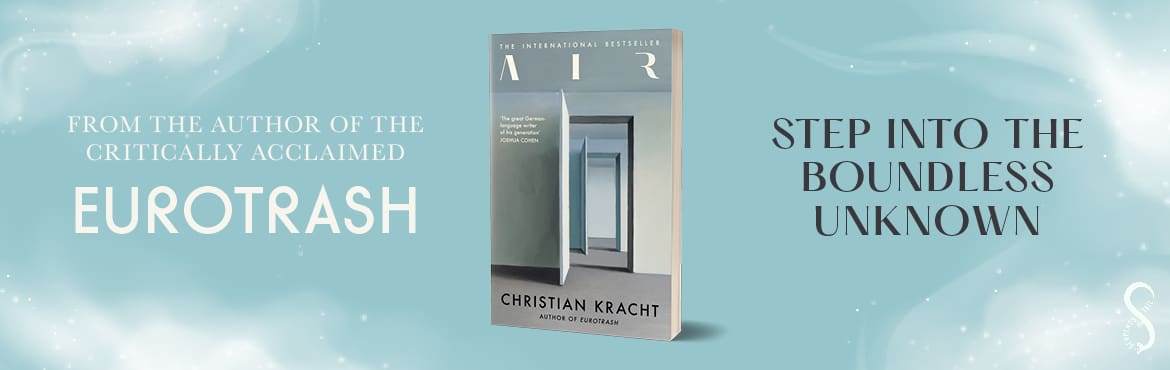
Two men venture through strange landscapes towards unknowable destinations. Paul, a feted designer, wanders the echoing corridors of a server farm in Norway – before, in a sudden blackout, he seems to vanish. In another time and space, a wounded stranger wakes in a forest, watched over by a young girl who helps him flee to an icebound settlement where perhaps he will find safety.
Inventive, enigmatic and chromatically resonant, Air is the seductively disorienting new novel from Christian Kracht, one of the most significant European writers working today. Heir to the ingenious fictions of Ursula K. Le Guin or Jorge Luis Borges, resistant to single interpretation, it unfolds as a haunting journey through a layered universe that may be a dream, the afterlife or reality’s inverted twin…
Read an extract from the opening of Air below.
Available from Waterstones | Bookshop.org | Amazon
This life, this sorrow. Both were imagined. It was a time when many things were quickly bought and just as soon forgotten. There was a spacious, quiet room in a little house along the water, in the harbor town of Stromness. It was early autumn. Outside the window, a sky of uncertain color drifted over the Orkney Islands, harried by immense thunderheads soaring into the heights. Soon it would be night, and once the clouds had gone, billowing curtains of green light would appear above. Stromness was a place far to the north, upon a grey sea: cold and stony and clean.
A silver grey laptop sat open on the bleached wood table. At the other end, there was a stack of Kūki magazines, their corners arranged at tidy right angles to the table’s edge. The issues were printed on recycled paper, and because the house in Stromness flanked the port’s harbor, the constant wetness had slightly curled their pages.
On the magazine’s cover, illuminated by the glow of the laptop: an earthenware, umber-colored dish with three walnuts in it and a few small, almost transparent seashells. Ona plate: a croissant, a bite missing. Under the table: a pair of dark green, knee-high Wellingtons. An old Swiss military bicycle was propped up against the far wall, which was of light grey stone. Its irregularities, grooves, nicks, and pockmarks heightened, rather than disturbed, the tranquillity of the space.
On the wall above the bicycle hung a framed oil painting of the sorcerer Merlin and the knight Lancelot done by the Scotsman James Archer in the late nineteenth century. Archer’s name was printed in black type on the lower crossbar of the gilt wood frame.
It was neither a particularly impressive picture, nor had it been particularly well executed by Archer. Merlin is draped in a long, light-colored cloak with a white hood over his head, obscuring his face. The dimming sun and a few gauzy clouds are daubed across the sky. Shod in sandals, Merlin strides ahead of the knight. Lancelot, noticeably weary, impassive, and preoccupied atop an equally weary black horse, follows the sorcerer, while Merlin leads him up the path into the realm of shadows, out of the frame to the left.
A bundle of reeds jutted from a tankard over on the windowsill, their sharp shadows rustling tenuously across the Wellingtons, then over to another pair of shoes. These now were Catalonian sandals, once tan, their heels worn in and worn down, their soles in the process of disintegration. Crumbs of leather from the sandals specked the floor just beside them, a concrete polished to only a partial sheen.
Spread over it, and there it was again, that tidy right angle: a dingy white sheep’s wool rug, greyish brown in places, not evenly bleached. In its center sat perched a one-eyed cat, gazing toward the window. The claws of her forepaws had snagged in the carpet. The animal kneaded them by turns, left and right, which produced a soft tearing sound.
In that corner of the room, beside that window in the house in Stromness overlooking the small harbor, on a sofa upholstered in threadbare sailcloth, lay Paul, asleep.
He felt as though he were floating, floating atop the crest of a long, smooth grey wave, drifting away amid a desolate slate-colored southern sea. Antarctica and its forbidden volcanic peaks were not far. Ghastly, they rose from the horizon toward which the wave carried him. It was almost a pleasant feeling, but not really.
One of those faded orange Penguin paperbacks had slipped from his hand in sleep and now lay beside the sofa on the rug. It was a book about aircraft recognition, published during the Second World War, that explained how to rapidly identify those Heinkels, Messerschmitts, Hurricanes, and Spitfires up above by their silhouettes. Each of the planes had a distinctive engine sound, too. And the shadow cast by each aircraft showed whether it was a Focke-Wulf or a Beaufort. Rain was a good omen. The sick were given water to drink from the seven springs. Rainwater, or the water of life, as it was known in Russia, healed all wounds, made lost limbs grow back, turned the old young again, and raised the dead up from the grave.
And then, at the horizon, where the waves’ ridges ended, there they were: those towering volcanoes blanketed in white, Mount Erebus and Mount Terror. Banners of snow whipped horizontally from their dread summits. And all of a sudden, his dream was an abomination. Paul awoke with a start. His shirt was soaked down below his collarbones, clingy and disgusting. Slept all day and woke up stupid, he thought. It was now late evening, and outside it was dark, though it never went completely dark here, in summer and in autumn.
Paul rose, dazed and much too slowly, felt for his glasses, went to the table, and gently touched the laptop with his index finger. The device and its screen, and the room, too, lit up. He looked out toward the rippling green of the auroras, there beyond the window, in the sky above the sea.
When he’d first moved here to the Orkneys, they had still seemed to him miraculous. He’d stared at them for hours, those squalls of solar wind, those ionic cyclones in the atmosphere, those photon storms. And now, after such a long time in Stromness, after appearing in the sky here every night, they had become mere decoration to him, an accepted, insipid part of the scenery whose magic for him had been snuffed out.