


11 December 2025
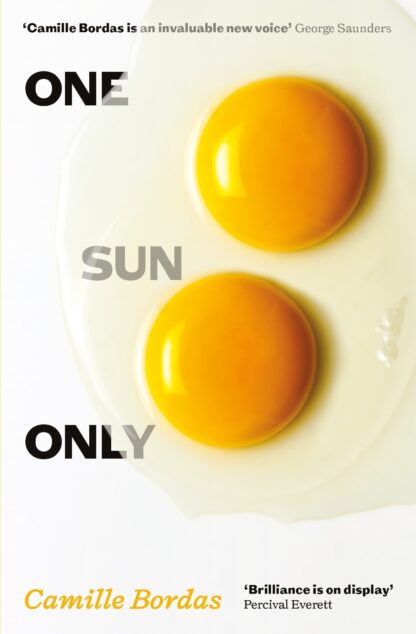
A young woman takes stock following a burglary. A teenager becomes obsessed with the obituaries in a weekly magazine. Grandchildren mourn the grandparents who loved them and the ones who didn’t. Painters and almost-painters try to distinguish Good Art from Bad Art. People grapple with life-altering illness, unrequited love and promises they have every intention of keeping. Some win the lottery. Some don’t.
In this prismatic new collection, Camille Bordas’s complex, wry, sometimes dark and always self-aware stories open a window onto the truths and misapprehensions of our shared, flawed humanity.
Read an extract from the titular story of Camille Bordas’ One Sun Only below.
Available from: Waterstones | Bookshop.org | Amazon
My phone rang. Nikki couldn’t help checking on the kids whenever they were with me for the weekend.
“I got a call from Ernest’s teacher,” she said.
“How are you doing?”
“Sorry. Yes. How are you doing? She says Ernie’s drawings worry her. She says he keeps drawing dead people.”
I left the living room.
“We know this already,” I said, once I reached my office. “It’s just a phase. Little boys are drawn to violent scenes.”
Nikki asked me to look through our son’s backpack for what he’d drawn at school that day.
“Describe what you see,” she said, once the drawing was in my hand.
What I saw was a single page with the instruction “Draw yourself many years in the future!” and my son’s response: a drawing of his own gravestone, with mine, his mother’s, and Sally’s surrounding it.
“Are there dates on the gravestones?” Nikki asked.
“Only on mine,” I said. “According to our son, I’ll die in . . . almost exactly two years.”
My ex-wife audibly shivered at the other end of the line.
“It’s just a drawing, Nik.”
I was pissed that Ernest’s teacher had called her instead of me.
“He shouldn’t be thinking about death so much,” Nikki said. “I think he might be traumatized.”
“Let’s not bring trauma into this. He’s had a rough year.”
“I’m surprised he didn’t draw your father’s grave,” Nikki said. “He misses him.”
“Does he?”
“We all do.”
…
While I made dinner, I let them pick their best work to Scotch-tape on the walls. After dinner, there would be bedtime, I determined. After bedtime, I could try to work, maybe finish that chapter I had been writing for weeks. The nights I had the kids were usually more productive. Since I’d bought myself a new apartment, a new desk, the right ergonomic chair, and a year off from my job, I’d discovered that I was the kind of writer who worked better when he was stealing time from other obligations. An hour here, two hours there, in between meetings, on my lunch break. I was better in a rush. Three months now of entire days at my disposal, and I’d written so little. In the mornings, I looked at what I had, despaired, and then read better writers than me for the rest of the day. Lately, I’d been looking at art books, too. My father’s collection had made its way to my living room. But tonight I would work well, I told myself, breading the cutlets. Because I’d been deprived of the possibility for a few hours, I would work well. Dinner, put the kids to bed, then work. I’d told Nikki I would talk to Ernest about his drawing of our family graves, but I knew I wouldn’t. How did one start a conversation like that? How did one keep it on track? It always looked easy in the movies. Mothers telling daughters how hard it was being a woman, fathers explaining death to sons in less than a minute, and, in both cases, explanations making sense, big warm hug, conversation over. I couldn’t do it. And what was wrong with drawing your own grave, anyway? There was something therapeutic about it, wasn’t there? We’d done it since Ernest was old enough to draw stick figures—drawn the things he was afraid of.
This reminded me of a book I’d read as a college student, one weekend when I was visiting my father. I’d taken it from his shelf, a slim volume about the drawings made by children in war zones, what could be learned from them. I don’t know why it had appealed to me. I guess I’d always been attracted to technically poor drawings—lines for limbs, squares for buildings, things that looked like I could’ve drawn them myself. My father had tried to make my interest sound fancy, said I liked “art brut,” but I don’t know if I liked it, exactly, or if I simply found comfort in it, its naïveté. If I could reproduce a drawing easily, then it meant that I could’ve been its creator in the first place, right? At least that’s what I thought as a child, when I copied Bill Traylor’s crooked houses and Henry Darger’s little girls with penises. My father had this rule that I had to make at least one sketch a day. I could keep copying, sure, you learned a lot from copying, he said, but it was important to come up with things of your own, too, your own way of rendering the texture of a lemon on a wooden table, for example, your own way of interpreting shadows on a sill. It was a person’s way of dealing with the small things that made him unique.
I drowned the cutlets in boiling oil, and realized as I watched them golden that I remembered quite a few things about the book. The book about children in war zones and what they drew. I remembered that roads that suddenly stopped, or mouthless faces, could be interpreted as signs of trauma. I remembered that traumatized children tended never to draw the sun. Ernest didn’t draw suns anymore, hadn’t drawn a sun in months, but maybe it was all right. Maybe he thought the sun was implied in most drawings, or boring to draw. And no sun in a child’s drawing was still better than several suns, according to the book, if memory served. Several suns could indicate developing psychosis, or even psychopathic tendencies. What you wanted, really, as a parent, was for your child to draw one sun and one sun only. But where would a sun have fit in Ernest’s drawing, anyway? The drawing of our family plot? Wouldn’t it have been worse if Ernest had drawn a sun there, over all our gravestones?